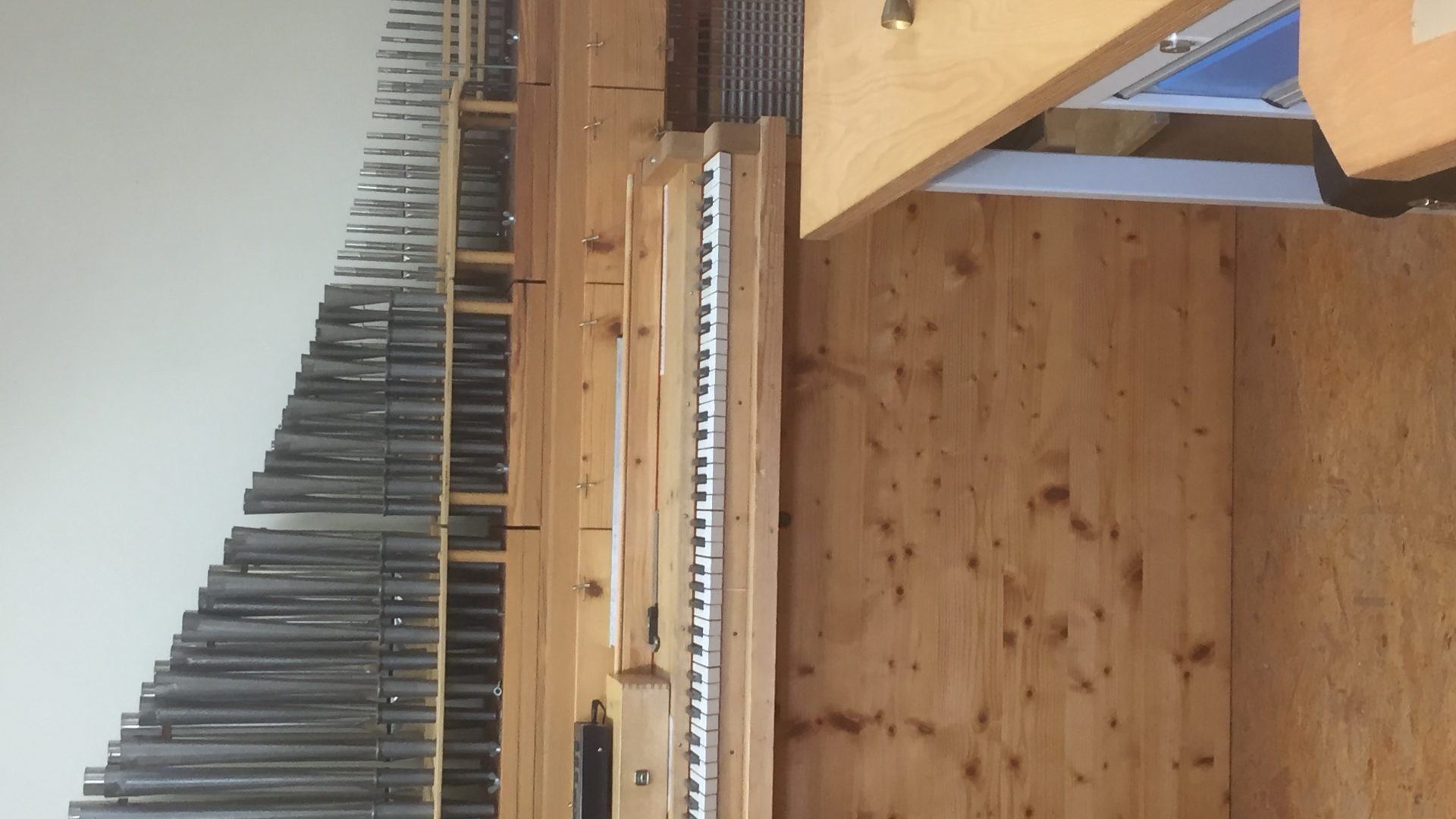
A pipe organ, new or restored, moves through five real stages from first conversation to final tuning. The list below is the same five stages used to plan every project in our portfolio.
-
01
Design & tonal planning
A stop list (specification) is drawn up against the room's own acoustics — a dry, carpeted parish hall and a stone-vaulted nave demand different scaling and wind pressure for the same nominal stop list. Manual and pedal divisions, action type (tracker or electro-pneumatic), and case layout are all fixed at this stage before a single pipe is cut.
-
02
Pipe construction & metal casting
Metal flue and reed pipes are cast from tin-lead alloy on a casting bench, planed to thickness, then formed, soldered, and voiced-scaled by hand; wood pipes are built from quarter-sawn timber. Alloy ratio is chosen per rank — higher tin content for brighter facade pipes, higher lead for warmer interior flutes.
-
03
Windchest & action building
The windchest — the wind-tight box that feeds each pipe on command — is built and leathered, and the key action (mechanical tracker linkage or electro-pneumatic relay) is fitted and regulated for even touch across the full compass.
-
04
Voicing
Each pipe is individually adjusted at the mouth — cutup height, languid position, nicking — to speak promptly, blend with its neighbours, and match the tonal character set out at the design stage. Voicing happens twice: once on the bench, once again on site once the pipes are speaking into the room they will actually live in.
-
05
Installation & final tuning
The organ is erected in situ, wind supply and action are regulated for the room's temperature and humidity, and every rank is tuned to the instrument's chosen temperament before the final acceptance inspection.
Why voicing happens twice
Every pipe is voiced once on the bench, under shop conditions, and voiced again after installation, once it is actually speaking into the room it will live in. A pipe that sounds correctly full and prompt in a padded voicing room can sound thin or slow in a reverberant stone nave, or blaring in a small, dead rehearsal room — the room is not a neutral container, it is part of the instrument, and the second voicing pass is not a formality.
Tracker action vs. electro-pneumatic action
A tracker (mechanical) action connects the key directly to the pipe valve through a chain of thin wooden trackers and rollers — the player’s finger controls the valve with no intermediary, giving direct tactile feedback many organists prefer for repertoire that rewards fine articulation. An electro-pneumatic action instead uses an electrical signal from the key to trigger a small pneumatic motor at the windchest, which allows the console to be physically separated from the pipework (useful in a large concert hall) at some cost to the direct “feel” a tracker action gives. We build and restore both, and the choice is driven by the room and the repertoire, not by a house style.