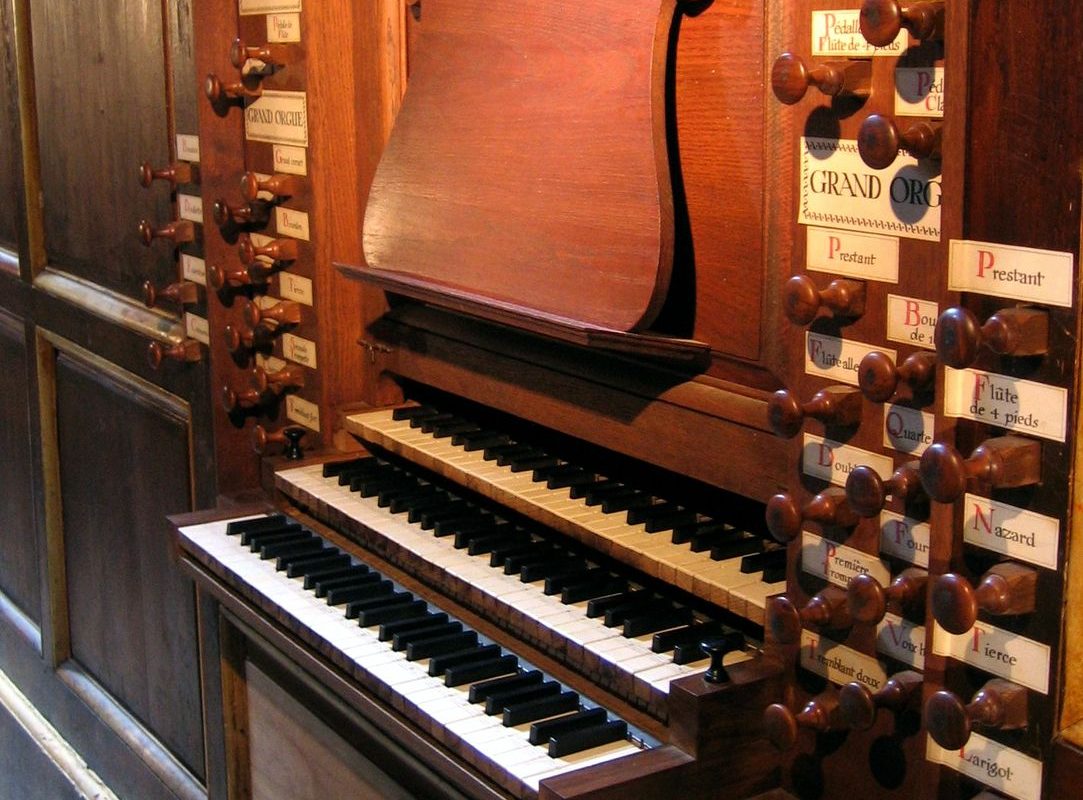
Tuning & Voicing Service
Pipe organ building & restoration workshop
A pipe organ building and restoration workshop — new tracker and electro-pneumatic instruments, historic restorations, releathering & mechanical overhauls, and ongoing tuning & voicing service for churches, concert halls, and private collectors.
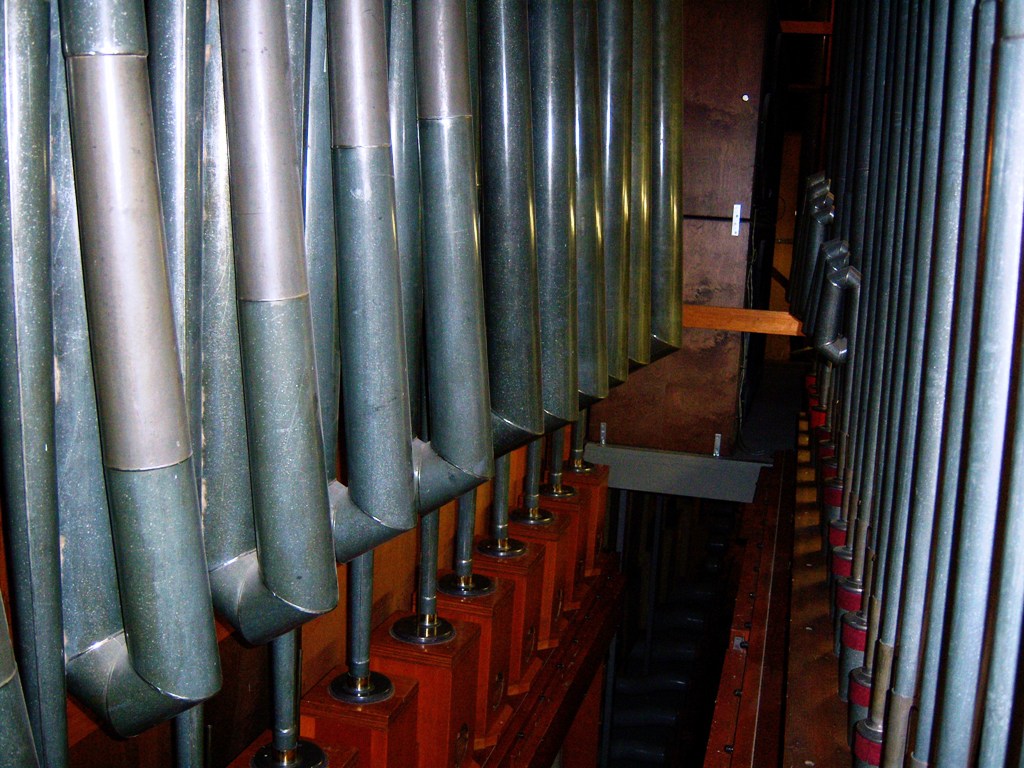
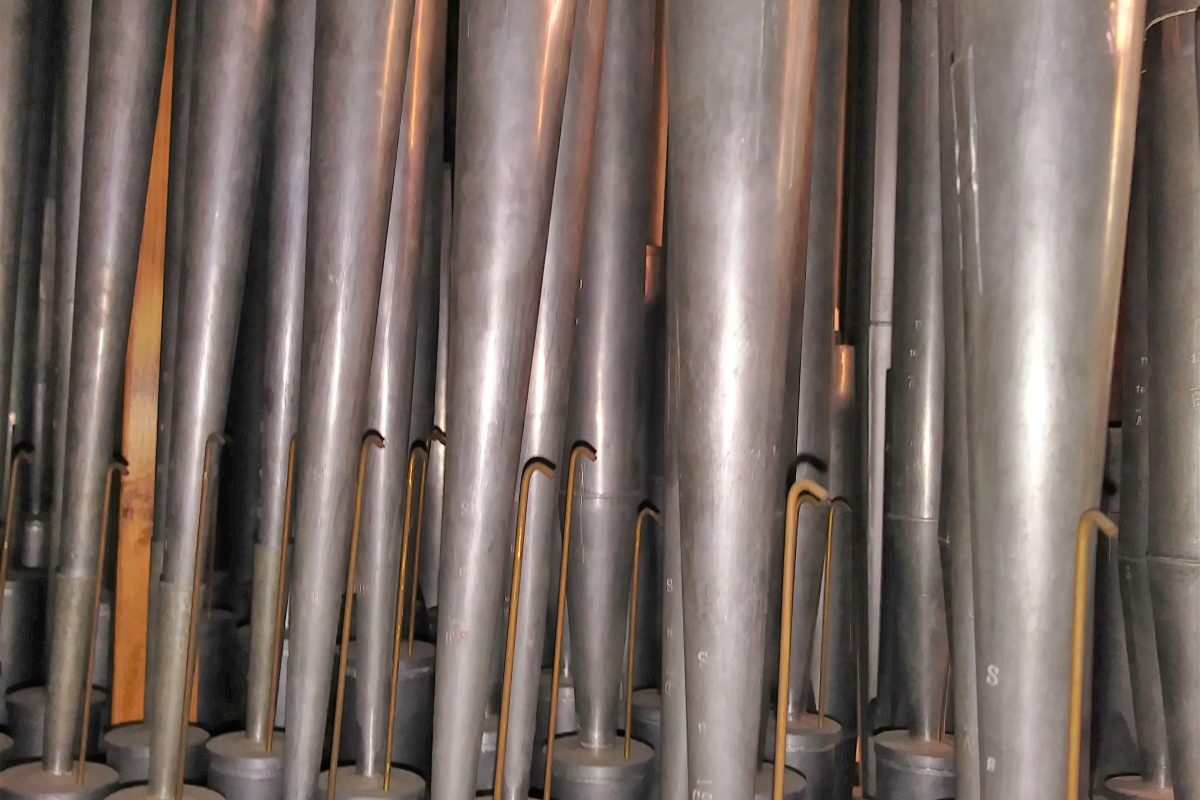
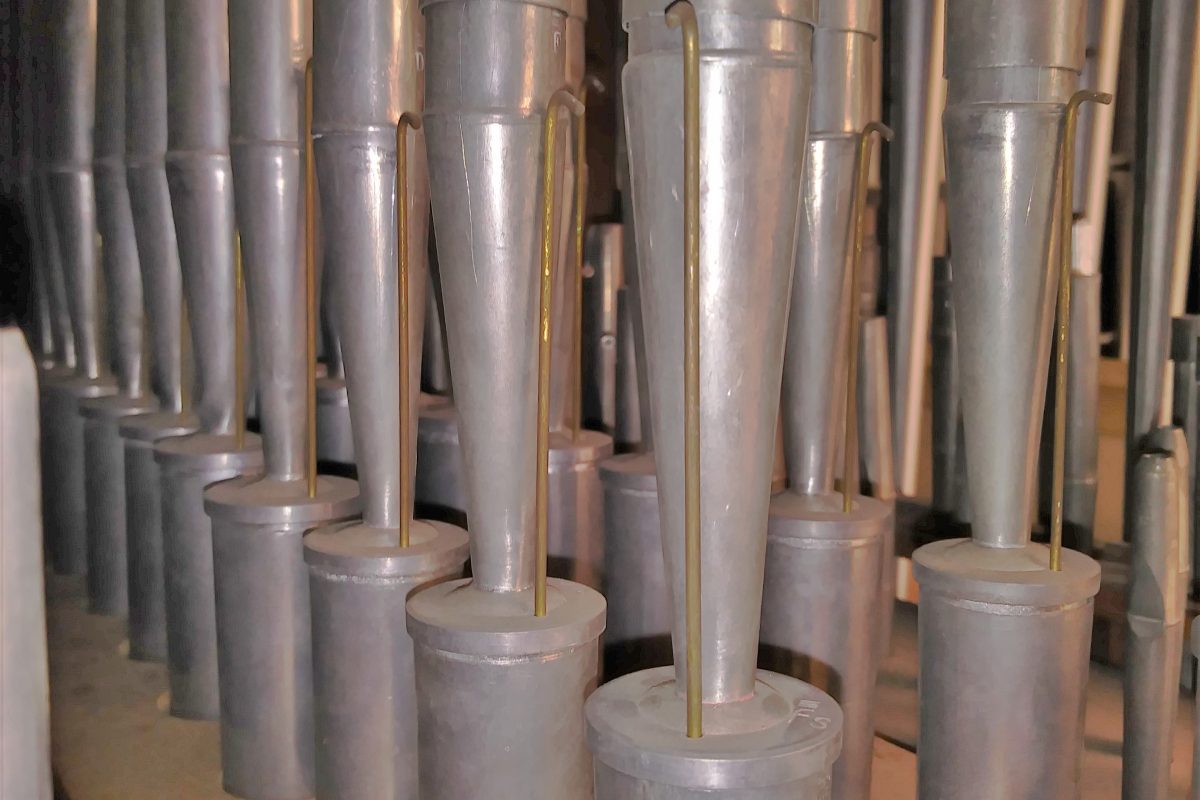

An open flue pipe resonates at roughly twice its own speaking length; a stopped (capped) pipe resonates at roughly four times its length — about an octave lower than an open pipe of the same physical size. Pick a note and a pipe type to see the real approximate physical length.
Approximate speaking length
65.63 cm (25.84″)
Open at the top: the air column resonates with a fundamental wavelength of roughly twice the speaking length (L ≈ v / 2f).
Idealized acoustic formula only — real pipe scaling (diameter, mouth cutup, wind pressure) shifts a real pipe's actual speaking length somewhat from this calculation, and the speed of sound itself varies with air temperature and humidity.
Formula: L ≈ v / 2f (open flue pipe) or L ≈ v / 4f (stopped flue pipe), where v is the speed of sound in air (331.3 + 0.606×T m/s, T in °C — 343 m/s at 20°C) and f is the note's equal-tempered frequency (A4 = 440Hz). Standard organ-building and musical-acoustics physics — see Fletcher & Rossing, "The Physics of Musical Instruments" (2nd ed., 1998).
Every organ stop belongs to one of four real families, defined by how the pipe actually generates its tone — not by name or decoration. Select a family to see its real construction and timbre.
Usually of moderate scale (pipe diameter relative to length) and unenclosed on the case front, historically the most visually prominent pipes on the facade.
Wide scaling suppresses upper partials relative to the fundamental, which is what gives the family its comparatively pure, fundamental-dominant sound.
Narrow scaling raises the pipe’s cutoff frequency for harmonic radiation, which is the acoustic reason narrow flue pipes read as brighter/thinner than wide ones of the same pitch.
Reed pipes go out of tune faster than flue pipes and are the primary reason organs need a regular tuning & voicing service visit, not just a one-time build.
Classification: standard organ-building practice — see Audsley, "The Art of Organ-Building" (1905), and the American Institute of Organbuilders' public educational materials. Reeds are fundamentally different from the other three flue families: a beating brass tongue against a shallot generates the raw tone, and the resonator shapes it — flue pipes generate tone entirely from air-column resonance at an edge tone.
In equal temperament every semitone is mathematically identical. Historical "well" and meantone temperaments deliberately weren't — certain keys were tuned purer at the real cost of others. Compare equal temperament against Werckmeister III, a real 1691 well temperament, note by note.
A historical "well temperament" by Andreas Werckmeister: four fifths (C–G, G–D, D–A, B–F♯) are each narrowed by a quarter of the Pythagorean comma, the rest left pure. Keys close to C major land noticeably purer than in equal temperament; keys far from C carry more of the tempering, in exchange — a real, documented tradeoff organ builders and tuners of the era accepted deliberately, not a flaw.
Werckmeister III (Andreas Werckmeister, 1691) narrows the fifths C–G, G–D, D–A, and B–F♯ by a quarter of the Pythagorean comma each, leaving the other eight fifths pure — a documented historical construction (see Owen Jorgensen, "Tuning", 1991). Per-note cents deviations are derived directly from that construction by standard circle-of-fifths arithmetic and rounded to one decimal place; published secondary tables vary slightly by rounding convention, so treat the tenths place as an honest best estimate rather than an exact-to-the-millicent citation.
For 38 years we've built new organs and restored historic ones for churches, concert halls, and private collectors — designed against the room's own acoustics from the first conversation, not a stock stop list. Every restoration is surveyed and documented before a single part comes off.
“They designed the stop list around our actual nave, not a catalogue specification — the pedal division alone changed how congregational singing feels.”
“They kept the original relay wiring diagrams and rebuilt to them instead of just bolting in a modern replacement. The organ sounds like itself again.”
“Our seasonal tuning contract has caught two problems before they became expensive ones. Worth every visit.”
“A small chamber organ built exactly to my music room, not scaled down from a church instrument. It sounds like it belongs there.”
Tell us about the instrument and what you're after — a new build, a historic restoration, releathering & mechanical work, tuning & voicing service, or an appraisal — and we'll follow up within two business days.